A humorous meditation on optimism, perception, and the age-old belief that life might somehow be better somewhere else—especially if "somewhere else" happens to be a dispensary.
Typically, I create a painting first and then spend days—or sometimes weeks—searching for a title that feels worthy of it. With Grass Is Always Greener (At the Dispensary on the Other Side of Town), I turned that process completely upside down. The title came first, and the painting followed.
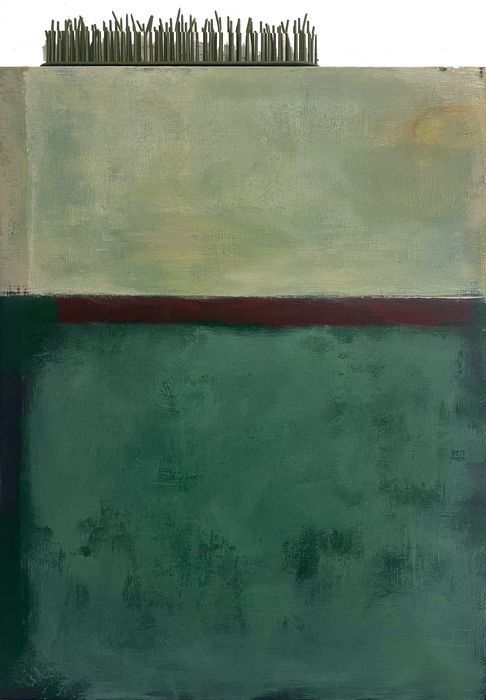
The piece was nearly finished when I glanced toward the shelf in my studio where I keep an ever-growing collection of interesting "found objects" rescued from thrift stores, garage sales, and junkyards. Sitting there was a green plastic countertop dish-drying rack that looked remarkably like a tidy little patch of artificial grass. I immediately knew it was about to experience a Robert Rauschenberg-style coronation—its transformation from a one-dollar yard sale purchase into an essential component of a work of fine art.
As I debated where to place it, my good friend Chief happened to stop by the studio for coffee and his customary dispensation of advice (mostly solicited). He suggested that instead of placing the grass inside the composition, I should let it break beyond the painting itself—allowing it to exist outside the picture plane. The idea instantly clicked. Suddenly the title, the painting, and the object all became part of the same visual joke.
The resulting work balances quiet restraint with a wink of humor. Its soft fields of muted green and earth tones evoke an expansive landscape, while the unexpected patch of "grass" disrupts expectations and invites a second look. By extending beyond the canvas, the found object blurs the boundary between painting and sculpture, encouraging viewers to question where the artwork actually begins and ends. Beneath its playful title lies a familiar human tendency: believing that fulfillment always exists just beyond our current horizon. Like much of the best satire, Grass Is Always Greener (At the Dispensary on the Other Side of Town) uses humor to reveal something surprisingly universal about hope, desire, and perspective.
• Mixed media on canvas
• 24x18x1.5 in.