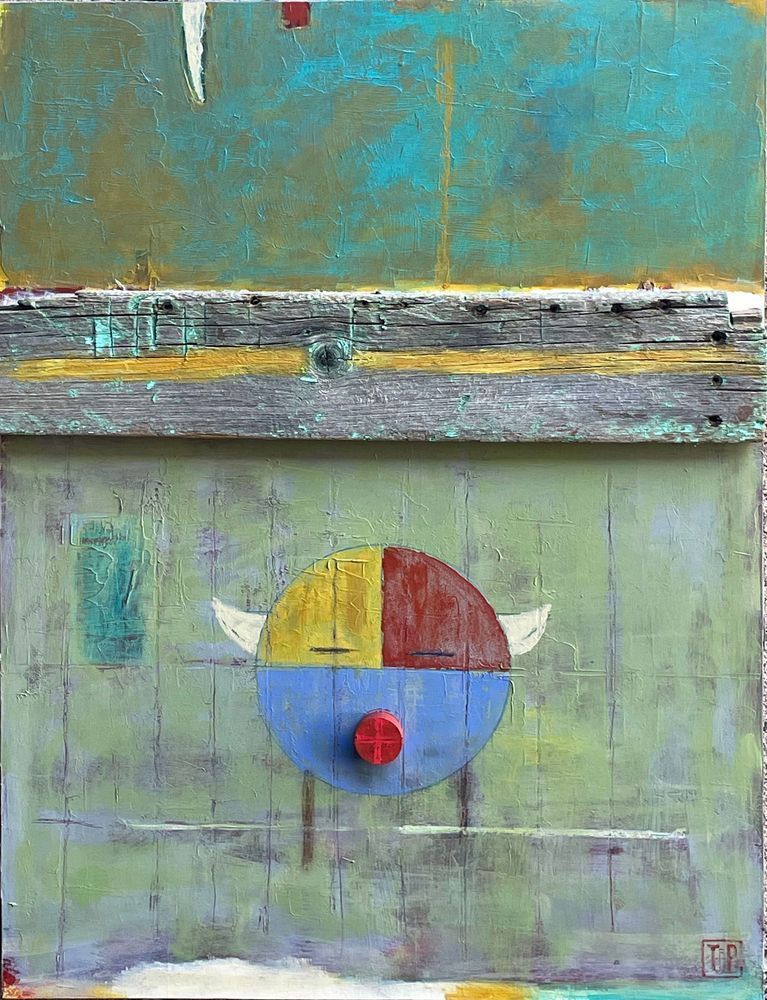
In Ghost of Silverheels, the original work featured a weathered surface of muted greens and earth tones is interrupted by a central, emblematic form—part shield, part figure, part symbol. Divided into bold quadrants of primary color and accented with horn-like extensions, the form suggests a kachina-like presence that is both playful and enigmatic.
Above, a reclaimed wooden slat spans the composition, grounding the piece in material history. Its worn surface, marked by age and use, contrasts with the layered painted field below, reinforcing a dialogue between past and present.
The original composition draws loosely on the spirit of folklore and the idea of lingering presence—something seen, remembered, or imagined. Subtle marks, drips, and surface variations hint at time’s passage, while the central figure holds steady, almost totemic in its simplicity.
Rather than offering a fixed narrative, the painting invites interpretation. It exists in that space between memory and myth, where objects take on meaning and presence is felt more than defined.