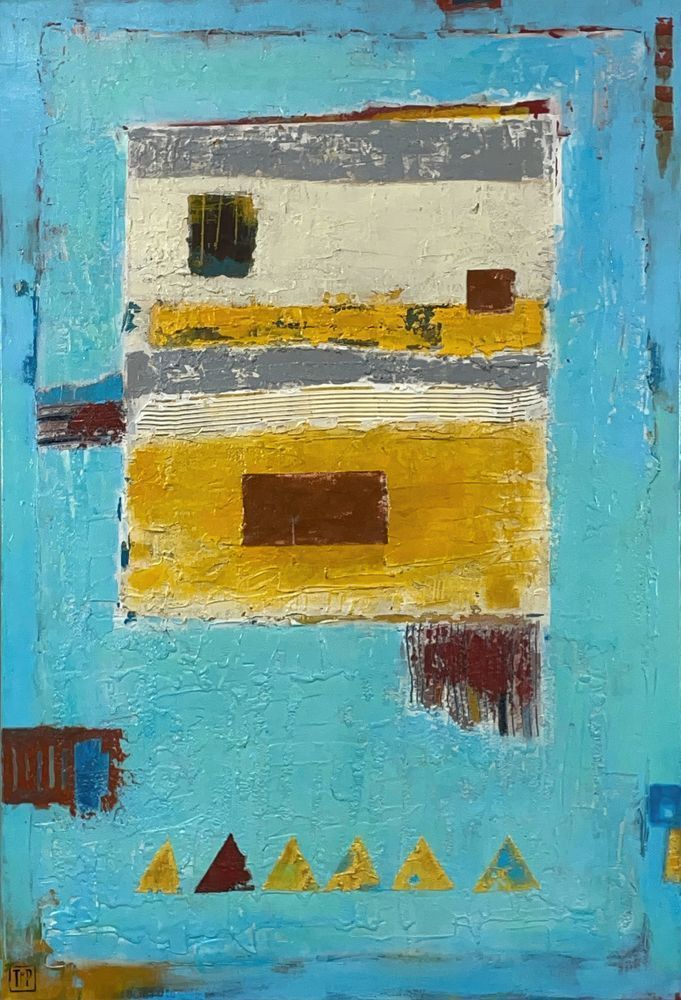
In Geronimo’s Blanket, structure and surface work in quiet harmony to evoke a sense of place, memory, and cultural resonance. A broad turquoise field establishes an open, atmospheric ground, reminiscent of expansive desert skies and sun-washed architectural walls. Within this space, a central form emerges—rectilinear and layered—suggesting the presence of a woven textile or ceremonial object suspended in time.
Bands of ochre, gray, and off-white create a rhythm across this central structure, their textured surfaces built up through impasto and subtle scraping. These passages carry a tactile weight, echoing the physicality of cloth, earth, and weathered materials. Smaller geometric elements—blocks, lines, and a row of triangular forms along the lower edge—introduce a symbolic cadence, hinting at pattern systems rooted in tradition while remaining firmly within an abstract language.
Rather than illustrating, this art reproduction suggests. It draws from the visual vocabulary of the Southwest—its colors, textures, and spatial sensibilities—without settling into literal reference. The result is a contemplative composition where balance, restraint, and material presence take precedence over narrative clarity.
Geronimo’s Blanket becomes less an object and more an echo—of landscape, of craft, and of enduring cultural memory translated through a contemporary abstract lens.