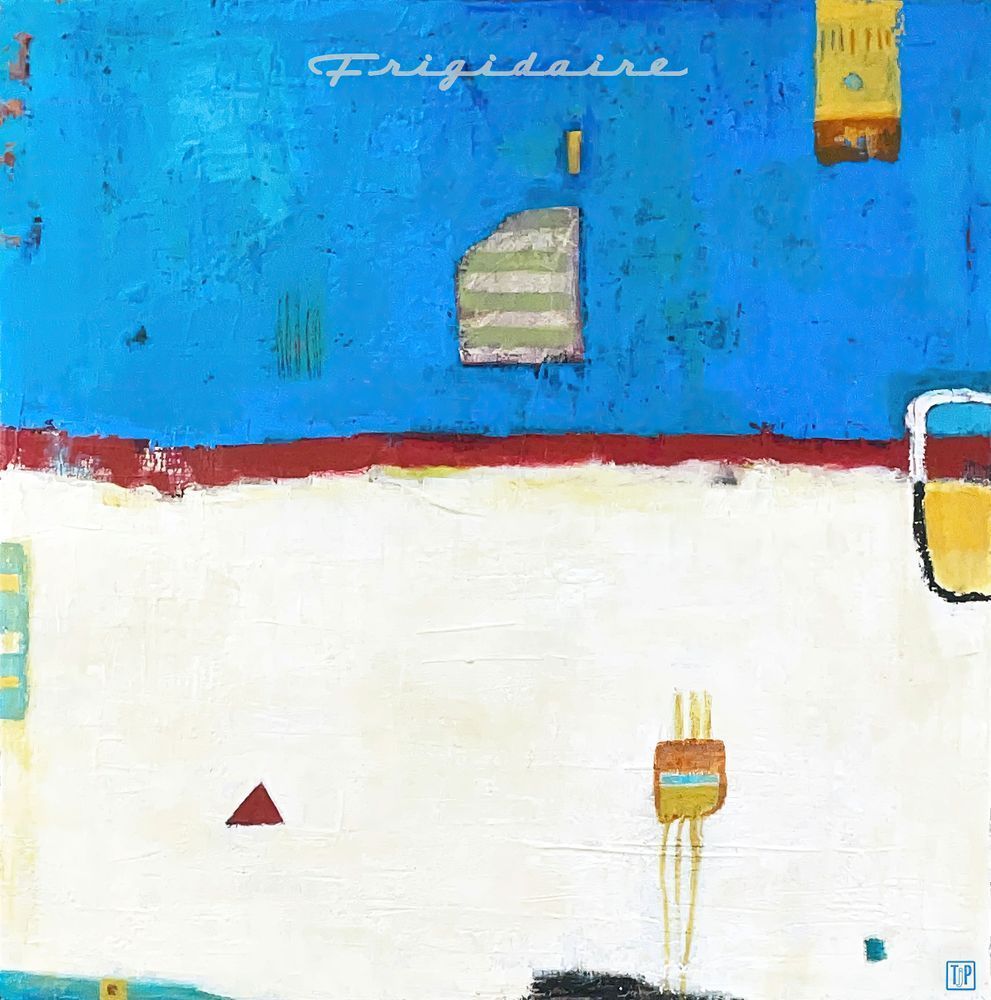
In Captain Jack’s Fridge, a vivid blue upper field hovers above a calm expanse of white, separated by a thin, grounding band of red. The composition suggests a horizon, yet resists becoming a literal landscape—existing instead in a space between abstraction and memory.
Scattered elements—fragments of paper, small geometric shapes, and subtle markings—appear like objects collected over time. They hint at stories without fully revealing them, inviting the viewer to piece together their own narrative. A central form, slightly elevated within the blue field, acts as a quiet focal point, while smaller accents create a rhythm across the surface.
There’s a sense of familiarity embedded in the work, as if these shapes once belonged to something functional—notes, magnets, or remnants of daily life—now rearranged into a more poetic order. The title suggests a personal archive, where the ordinary becomes meaningful through time and attention.
This reproduction balances playfulness with restraint, offering a composition that feels open, lived-in, and quietly evocative.