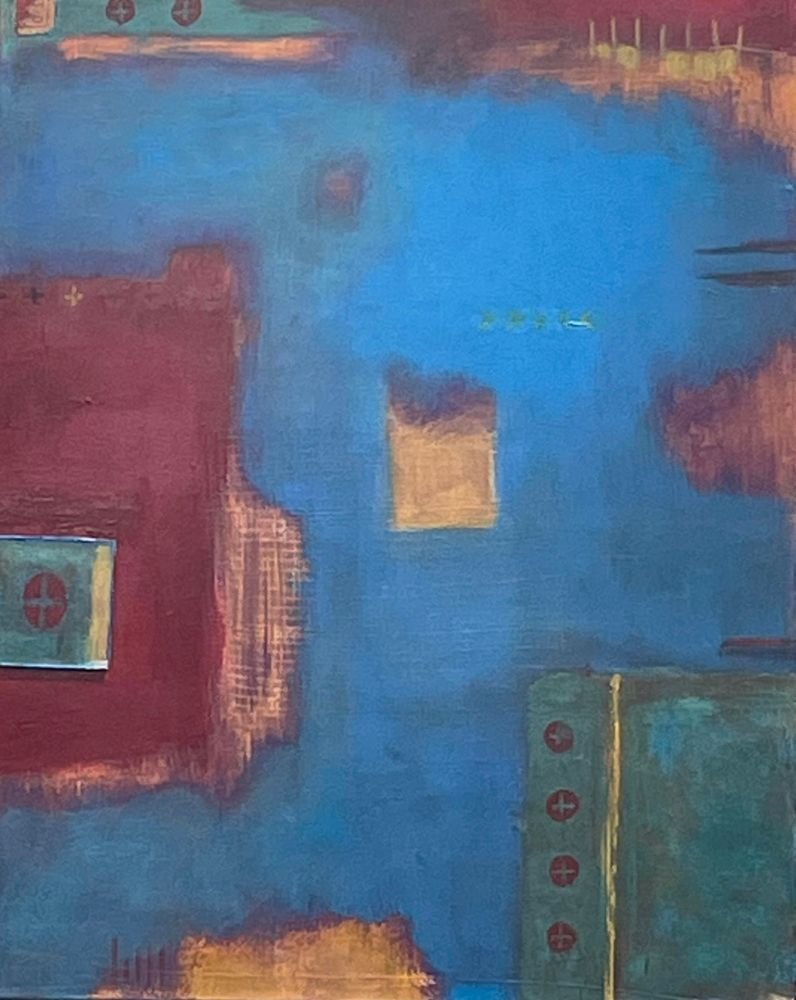
Color carries the emotional weight in Invitation to the Blues, where a luminous expanse of blue becomes both setting and mood. Anchoring forms in red and ochre emerge and recede along the edges, suggesting fragments of structure without fully resolving into fixed shapes. The surface is alive with softened transitions, veiled layers, and faint linear accents that move the eye gently across the canvas, creating a sense of slow, internal rhythm. There is a push between openness and containment—areas that breathe alongside those that feel held or compressed—mirroring the ebb and flow of feeling itself. Much like Tom Waits's Invitation to the Blues, the work leans into a space that is less about narrative and more about atmosphere—where tone, texture, and restraint shape an experience that is reflective, dreamy, and deeply human. Color carries the emotional weight in Invitation to the Blues, where a luminous expanse of blue becomes both setting and mood. Anchoring forms in red and ochre emerge and recede along the edges, suggesting fragments of structure without fully resolving into fixed shapes. The surface is alive with softened transitions, veiled layers, and faint linear accents that move the eye gently across the canvas, creating a sense of slow, internal rhythm. There is a push between openness and containment—areas that breathe alongside those that feel held or compressed—mirroring the ebb and flow of feeling itself. Much like Tom Waits's Invitation to the Blues, the work leans into a space that is less about narrative and more about atmosphere—where tone, texture, and restraint shape an experience that is reflective, dreamy, and deeply human.