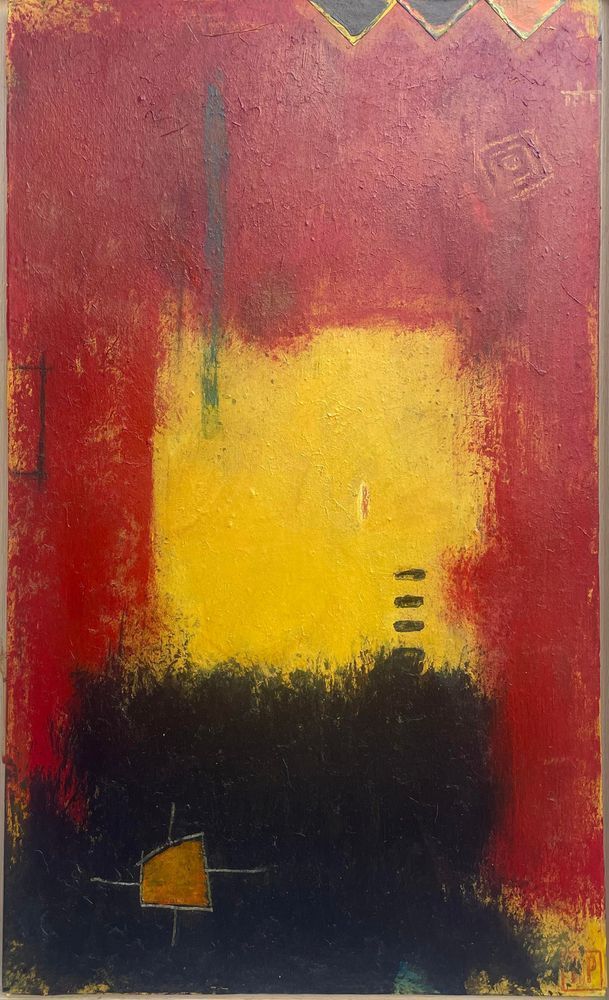
In Eclypso, a radiant field of yellow emerges from a surrounding expanse of deep red and near-black, creating a composition that feels both grounded and celestial. The central form appears to glow from within, as if partially revealed through layers of atmosphere or shadow.
The original painting's surface is richly textured, with areas of abrasion, transparency, and buildup that suggest a process of continual refinement and discovery. Subtle marks and geometric hints—lines, symbols, and faint structures—punctuate the field, adding quiet complexity without disrupting the overall balance.
The composition evokes a moment of transition, where light and darkness meet and overlap. The title suggests an eclipse—an event defined not by disappearance, but by alignment and transformation. This high-quality reproduction captures that same sense of suspended energy, where opposing forces coexist in a state of tension and harmony.
Rather than resolving fully, the image holds its position—inviting the viewer to sit within that moment of shift, where clarity and obscurity exist side by side.